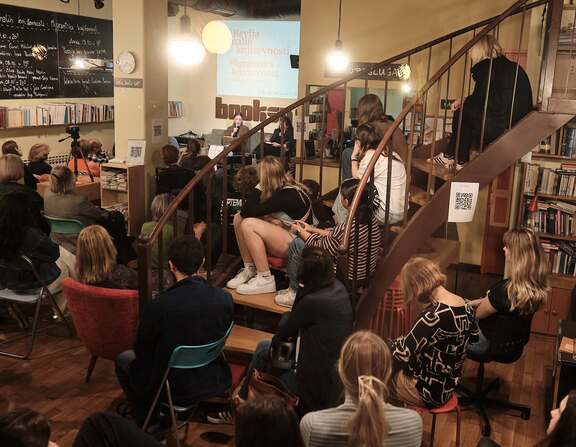
Foto: Vanja Babić.
“Your homeland lives inside your head, inside your mind… I have my past here. My past is different from your past, and different from your past. But, for tomorrow? For next? I’m trying to tell you some beautiful sentences about tomorrow.” (Muhamad Abd Al Monaem, from Day 1 of the Review of Small Literatures: Migrant Literature)
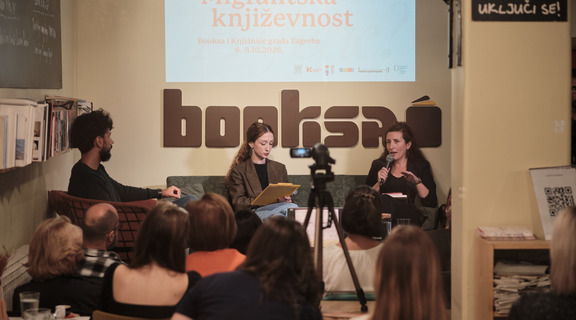
Booksa had the privilege of hosting a panel of seven poets and prose writers from around the world for this year’s Review of Small Literatures, lasting from October 6–8. The theme of the festival was migrant literature, and over the course of three days, we interviewed our guests and invited them to read samples of their own work aloud to audiences in English, Spanish, Arabic, Azerbaijani/Azeri, Uzbek, Russian, Belarusian, Farsi, Turkish, and Uyghur. Each of the guests, in addition to Angolan-born author, artist, and activist Aaiún Nin and Iraqi poet Raša Al Kasim, was featured in this year’s Booksa anthology Dobro smo. A vi? (ed. Miljenka Buljević and Ivana Dražić). In every language spoken, diaspora story shared, and experience-verified insight given, bold speakers processed with us the human experience through the lens of identity-formation at a distance from one’s homeland.
Booksa’s Review of Small Literatures is a tradition dating back to 2005, which initially emerged as an initiative to showcase prose writers and poets whose work had not yet been published in Croatia. While continuing to do so, the Review of Small Literatures has since expanded inclusion to authors from not just the Balkans, but from Western Europe, Southwest Asia, North Africa, and more. The effect of the tradition in serving as a platform to elevate literatures into the zeitgeist of literary conversations in the Balkans has been understated but sure: “For example, when Booksa first included Bulgaria in the Review of Small Literatures, there had been no translation from Bulgaria for over thirty years. Ten years later, there were 15-20 translations of contemporary Bulgarian literature.” (Molly Talbot, Twenty Years and Counting: Booksa’s 20th Anniversary in Reflection).
Resonating strongly throughout the interviews of the first night, the first half of which was moderated by Booksa literary editor and digital portal editor-in-chief Ivana Dražić, was the notion of this search to reclaim one’s lost humanity beyond the stigma and isolation created by labels such as “migrant” or “refugee” through literature. “Although you cannot always relate completely to every individual story, the sense of…losing the ground beneath your feet is something that people very well understand,” shared Serbian writer Ognjen Aksentijević, author of poetic works Rezervat odbeglih ptica (2021) and Um za morem, smrt za vratom (2017), and novel Tesna zemlja (2025), on the first night of the festival. Aksentijević, who returned to moderate the interviews given during the second half of the first night, noted that the perception of migrants in society are often influenced by eurocentric ways of thinking. He argued that literature should try to restore that sense of common humanity that we all share and destroy the orientalist and other false conceptions that we make of ourselves and each other. Emina Bužinkić, Croatian activist researching migration and adjacent topics of transnational solidarities, suggested an important difference between characterizing someone by “migrant background and migrant origin.” Understanding someone as having a migrant “origin”—or even just using literature to merely miserate an audience about another person’s suffering—suffocates the beauty of their complex identity by falsely using temporal circumstances they didn’t often choose as the lens through which one understands their entire life and existence. And yet, we tragically have this tendency to trivialize one another like this.
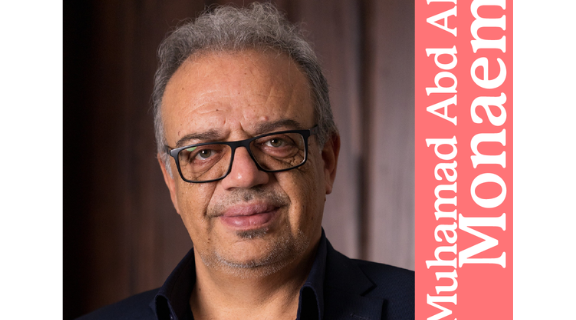
“The borders live inside you,” described Syrian-born Palestinian writer Muhamad Abd Al Monaem, member of the Slovenian PEN Center and the Slovene Writers’ Association, whose poetry in the anthology was translated from Arabic by Antonia de Castro Burica. The borders are not just the lines that separate our land physically, but they are the barriers that live on in the labels we put on each other and accept in ourselves, which, he explains, is how we end up with such social binaries as that between “citizens” and “refugees,” for example. This internalized separation leads to a twofold tragedy where we fail to see both the other and ourselves as truly human. It is beautiful that we have different cultures, Al Monaem says, but the idea that we have that we are our identities should not exclude anyone from being or perceived as anything other than fully human.
The festival’s first night also gave us some important pearls regarding war’s ability to diminish our recognition of a person’s humanity and to never lose sight of humanity on the micro-scale even when the news and politics only talk about the macro-scale. Award-winning Ukrainian-born Spanish writer and journalist Margaryta Yakovenko, who joined us via Zoom alongside Al Monaem, beautifully developed the discussion on reconciliation of identity and the past in a migrant experience specifically shaped by the reality of the heartbreakingly-recurring historical cycle of war:
“War does not only extinguish physical lives instantly: it slowly dismantles all the world that we have built…And the basic dignity you deserve at the final stages of your life…it’s evaporated because it no longer exists. All that you believe is taken out of you. It’s taken away not from just the present, but the past—the peaceful past that you remember is disappearing, too, at the same time.”
In her literature, Yakovenko intends to humanize the viciousness of war and bring the micro-scale of the human experience during war back into focus. The excerpt from her novel Occupation was translated from Spanish by Željka Somun. Earlier, Emina Bužinkić argued that choosing to write or not write literature is inherently a politically-motivated choice: literature not only has the power to build an audience’s solidarity with the stranger via individual encounters with him/her, but our “cognition of literature” is meant to help one’s own articulation of reality and identification of where the power struggle of politics is to break the devastating cycles. Yakovenko’s motivation to write was the common one shared, really, by all guests during the first night of the festival: using literature to testify of the human experience of one whose humanity is threatened by not only the specter of war, but also the misuse of labels, divisive social norms, orientalism, and even the loss of one’s voice itself, among other threats, when a person’s relationship with home is suddenly complicated by life.
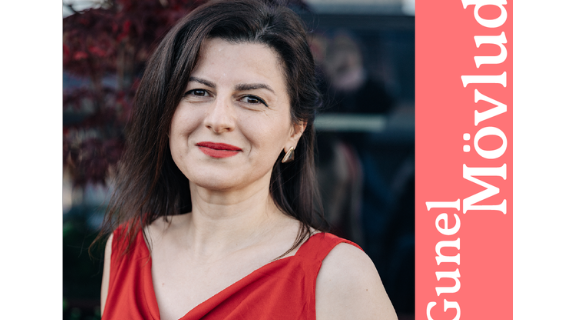
On the second night of the Review of Small Literatures, two guests gave meaningful and vulnerable testimonies of their complicated relationships with their own homelands while they both unraveled the craft of writing’s mystery in its ability to challenge rigid political structures. We were joined by Uzbek novelist, poet, and journalist Hamid Ismailov, whose short story The Stone Guest is translated into Croatian by Lara Radović and included in Dobro smo. A vi?, and Azerbaijani poet and journalist Gunel Mövlud, whose work discusses subjects such as women’s rights, sexuality taboos, and other democratic freedoms of expression. Her poetry was translated from Russian by Ivo Alebić. Ivana Peruško, Croatian translator, professor, and literary scholar, moderated the conversation.
Ismailov, living in exile from Uzbekistan for the past 34 years, described literature as the processing of what one sees, and he understands his own literature as illustrating a clash of realities: the disparities between what the politicians tell you and what life does, among other dissonances. A polyglot and scholar of many storytelling forms, he insists that we can learn from every storytelling format, and different languages can yield different potencies for different literary intents and purposes. Being able to more aptly capture the truth of one’s experiences in literature is critical when writing for audiences in countries where the truth is systematically obscured and lies are socially and politically disciplined into the individual and society alike.
Mövlud resonated with this notion, humorously suggesting that in her experience, sexuality is much more colorfully portrayed in Russian than Azerbaijani. But in any language, even in a modern era where women in Azerbaijan had more freedoms than in the Soviet era, which she argued was itself an era where women had more freedoms than in the pre-Soviet shariah-oriented state, Mövlud offered the critical insight that women still do not have the luxury to not be political in a patriarchal society, and neither does anyone else whose identity and freedoms are under threat of social or political marginalization. Literature, which she said started out for her as a “shelter” during the challenges of her childhood in a poorer patriarchal family and then later when she was internally displaced within Azerbaijan due to war, evolved into something of a tool that she realized she could use for political change. She, like Ismailov, currently lives in exile from her home government for her challenge of the state’s socio-political norms and belief in this change.
So, too, does Abide Abbas Nesrin, who joined us via Zoom on the third and final night of the festival, live in diaspora outside of her home as one who fights for change. Born in the Xinjiang Uyghur Autonomous Region of China, Nesrin was forcibly displaced from her home due to living under oppressive circumstances as a Muslim minority. Translator and president of Croatian Reading Society Ksenija Banović moderated the conversation with Nesrin. Sanja Virovec, literary translator and senior assistant at the Chair of Turkish Studies at the University of Zagreb, translated Nesrin’s Turkish into Croatian for us. Her poetry in the anthology was translated from Czech language by Mateja Pavlic, some of which she read aloud in her native language, Uyghur.
To live in such a rupture as this, Belarusian poet and translator Julia Cimafiejeva, whose poetry from the collection Krvotok is translated from Belarusian to be featured in Dobro smo. A vi? by Tatsiana Mazzuchelli, argues, is what it takes to write. “The condition of being a writer is that disrupture,” says Cimafiejeva. Her fellow panelist Fariba Vafi, award-winning Iranian novelist and poet whose work People from the Past Life is translated by Azra Abadžić Navaey and excerpted in Dobro smo. A vi?, doesn’t necessarily agree in this regard. The interviews with Cimafiejeva and Vafi were moderated by journalist and Booksa literary program moderator Anja Tomljenović. Ebtehaj Navaey translated Vafi’s Persian into Croatian during the conversation, and Tomljenović subsequently translated her remarks into English for the audience. Vafi’s perspective on the matter of what being a migrant does for a writer was that it gives you a kind of “third eye”: you see what’s in front of you and what’s in your thoughts. Literature doesn’t need to depend on the world around us, she argued, but the past is like a material and inspiration for writing—the perception of which is constantly changing.
Cimafiejeva, for whom the experience of being exiled from Belarus to Berlin she says was that of becoming a child again, describes the relationship between the spatial-temporal such that only the present is real, and past and future only exist in our stories. Having distance from the object of a story, therefore, is what makes great literature, lest it become journalism for being too close. Living riven from home has allowed her to harvest the full poignancy and vividity of her past and future in her literature. Vafi concurs that distance from the place of inspiration fuels the desire to give life to it in writing, having chosen voluntarily to move from Iran to Berlin to accept a prestigious artistic fellowship rather than in exile as Cimafiejeva. Her literature rises from a past where she characterized herself as being a child who was a stranger in language that grew up in a country where more and more female writers gradually started finding their voice over time.
Writers constantly make existential choices. They make choices in content which can attract physical threat to themselves and one’s loved ones, even resulting in exile from home. Writers must choose who they represent themselves as in the languages they choose to write in—they must choose a “prison,” as Cimafiejeva so tersely describes language, in terms of which to define their life experiences. Writers choose to be resistant to power by speaking or complicit to it by remaining silent, as Bužinkić warned, and if the charge of Al Monaem’s wisdoms had any merit, then choosing to write can be as important as choosing to re-dignify one’s own humanity against encroaching threats to it that can take shapes as overtly destructive as war or as understatedly deceptive as prejudice. This year’s Review of Small Literatures' captivating conversations showcased the unique potency of migrant literature—whether literature can be characterized as such by subject matter, form, or even the story of its author—to be able to reveal to us something about ourselves, each other, and, perhaps most idiosyncratically to this theme, home.
JP Sanchez
This feature was produced in collaboration with European Center for the Study of War and Peace.
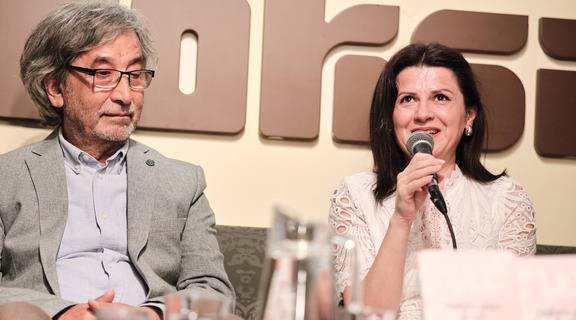
Donosimo snimku razgovora s Gunel Mövlud i Hamidom Ismailovom, koji se održao u sklopu Revije malih književnosti, posvećene migrantskoj književnosti.

Donosimo dio predgovora antologiji "Dobro smo. A vi?" urednica Miljenke Buljević i Ivane Dražić, koja izlazi povodom Revije malih književnosti: Migrantska književnost.