
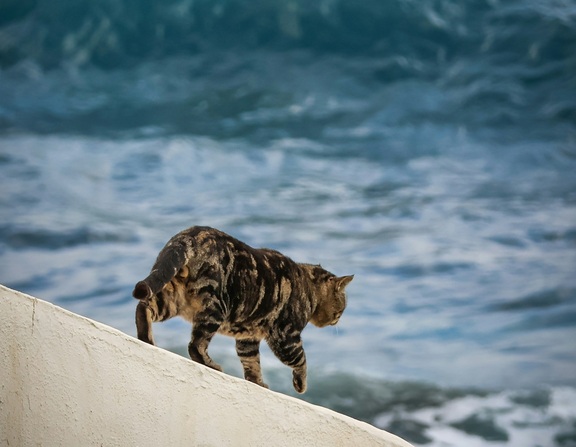
Sandro Moser, Unsplash.
“‘Slavery is a mark,’ she told him. ‘It comes back when it is mentioned. Don’t ever mention it, even if it means forgetting me too’” (Perišić, 2022, p. 206).
Robert Perišić’s A Cat at the End of the World (titled Brod za Issu in its original Croatian language; published by Sandorf both in Croatian and English language) transports us back to the origins of an ancient Issa (modern-day Vis town on Dalmatian island Vis) as a Greek apoika (“home away from home”) viewed with the novelty and sensitivity of a child seeing the world—or, rather, its end—for the first time. Kalia is born into slavery in Syracuse, which would have been the largest Greek polis at the time of Issa's 4th century BC construction when the Greeks spread the polis as an expression of their cultural ideals and conceptions of social purity. One day a sailor brings a cat all the way from Egypt into Kalia’s master’s courtyard, and here is the beginning of the end of the world.
The cat, Miu, refuses to submit to the master’s entitled son Pigras, and instead it takes a liking to Kalia. A violent altercation between Kalia and Pigras forces Kalia to flee for his life from his master’s house, and he takes Miu with him. Now runaways, the frightened Kalia and Miu stick together and sleep in the stable of the donkey Mikro before bringing Mikro with them to set off the next morning on a boat headed for Issa. Kalia meets the Syracusan stonecutter Teogen and, with no other options before him, boards the boat with Teogen’s crew as a worker, leaving behind home and everything he’s ever known with Miu and Mikro as his only family.
The novel is structured as a frequent switching of perspectives between two main characters: Kalia in his coming of age as a builder of the Issan polis, and the digression of the nebulous wind spirit Scatterwind. Kalia struggles with the conflict between the ecologically-objectifying ideals that Teogen teaches him shape the polis and his own proclivity to embrace nature’s inherent valuation outside of its submission to the human mind. As Kalia also tries to reconcile his own identity while in Issa and far from home, the critical Scatterwind offers illuminating insights into the character-setting dynamics at work via their introspection as they grapple with their own existence.
For instance, the formless, ageless, genderless, and even self-less—“self-less” as in, lacking individual identity—Scatterwind suggests that words are intrinsic to the polis, and they always take the side of those who rule it. During the third night of Booksa’s Festival of Small Literatures, this year the theme of which was migrant literature, Belarusian poet and novelist Julia Cimefiejeva remarked that language is a prison through which you experience the world, and this prison is one that you can only make wider by learning new languages. In quite a prison-widening way, both Kalia and Scatterwind develop their subjectivity through language in relation to the construction and observation of the Greek polis: Kalia through self-perceived objectivity in slavery, and Scatterwind through a complete lack of ipseity. For example, the concepts and words that Teogen teaches Kalia does indeed serve to expand Kalia’s agency in that it allows him to participate in society beyond the slave objectification in which his only sense of self was that he was less than his master Sabas’s son, who himself was less than his master. However, Kalia must now reconcile with Issa as his own apoika while a social misfit who resists the conventions of civilization in the polis as he struggles to reconcile with the sentiments of domination and subjection inherent in the rhetoric that creates the polis.
This much is also true for Scatterwind, who critic Matija Prica describes as the unconcealed voice of nature in his own literary criticism of Brod za Issu. Scatterwind is highly critical of humanity, although language much more directly is a bondage to Scatterwind than Kalia. The fixations of space, time, and the personal “I” that language respects are limited, human things that threaten Scatterwind’s space, time, and even identity transcendent nature. In experiencing human cognition, they begin to experience human feeling: “I don’t think it would be possible to think without feeling, because there would be no motivation for it” (Perišić, 2022, p. 208). The self that Scatterwind becomes as they begin to use language is the very apoika that this particular character starts to reckon with: where the new, now temporal version of themself that is in likeness contradictory to the version of themself that they once were is itself the diaspora. This proves to be an existential threat to who this character is.
Here is where Vesna Marić’s shift of the title from Brod za Issu (“Ship to Issa”) in Croatian to A Cat at the End of the World for the English translation of the work becomes thematically significant. Perišić uses an interesting ensemble of social outcasts who all leave the place they once called “home” on a boat and find themselves on Issa to reduce humanity back to its natural origins. Marić’s English translation doesn’t conceal much meaning in subtext, as the characters, more or less, say exactly what they “mean,” per se. But the experience of comparing the characters’ words with their actions and the different ways they perceive each other versus themselves results in such a subtext that reveals the discrepancy between the realities that characters think they live in and the realities that their arcs and interpersonal dynamics illustrate. The original Croatian title offers the sense that the novel will transport readers across space and time towards a familiar place’s ancient origins, perhaps even emphasizing that experience of the journey itself as an agent that transforms how readers will see the place when the story is over. The title of the English translation, however, seems to encapsulate the mysteriously affective experience of the sense of rivenness from home and foreshadows Perišić’s usage of cats as images that evoke nature’s autonomy and uniqueness apart from humans.
The difference between cats’ and humanity’s relationship with language illuminates humanity’s use of language to increase its distance from nature. Our main cat, Miu, as well as her feline lover, El, are both introduced under guises of mystery and only become more mysterious the more time Scatterwind and our human characters spend in their company with pursuit of and attention to these cats. Cats do not use human language and, thus, do not experience time. They have memories which are harmonious and sensible, but simultaneously coexistent and as wordless feelings and thoughts. In this way, they have similar characterizations to Scatterwind within the story and share literary functions with them in this brilliant work: they experience memories without time and identity without slavery. These can be disguised by human language, but never truly erased.
And perhaps this close characterization of the wind spirit and the cats also explains why Scatterwind takes such a liking to those who are also misfits in the polis in the same way that it recognizes its own misfitting to culture by virtue of its reluctance to embrace the same medium of language. We watch the development of cats as a symbol of the freedom of nature, fully immune to the slavery of humanity, and the last of animals to be domesticated, who only become so by choosing it—not by doing anything first. Scatterwind resonates with these creatures, who, from their perspective, rise above the illusion of slave identity given to nature by humanity when they build the polis. They are bastions of nature who have been thankfully spared the fate of the donkey, which are represented in the book through Mikro and, later, Isiha. Donkeys were bred by domestication practices specifically for slave labor and whose swelling and inflammation on the bones visible to archeologists even thousands of years later are the result of humans interpreting nature in terms of the dominating ideas of the polis.
Teogen, a man of the polis and for the polis, with a vision of only the city in his mind that is guarded by the fortress to let nothing else obstruct this vision, sees “not a better creature” than his donkey (Perišić, 2022, p. 263), Isiha, who he brought with him to Issa from Syracuse. Yet, he also despises the friendship between Kalia and Mikro, which he doesn’t have with his own donkey, and tries to mount Mikro to no avail to assert his dominance over it. Symbolically, Teogen fails to show himself greater than the donkey, and they really have become equals. Kalia, who Prica points out is a rebel against the traditional social inequalities by virtue of his very lack of understanding them, doesn’t understand why Teogen wouldn’t know this in the first place.
Perišić makes powerful, but subtle, implications about language using Kalia’s subjectivity in such lines as “Syracuse felt dead in the bleak silence, but this never frightened [Kalia]. It was when he most felt it belonged to him” (Perišić, 2022, p. 135). In this same scene, Menda, the slave cook from the master’s house in Syracuse and who is instrumental in securing Kalia’s emigration, thought that “The more visions of the future [Kalia] had, the better the chances for him to survive, she felt” (Perišić, 2022, p. 142). As she does, we get the foreshadowing of the exact mind that Kalia will come to resist and have tension with when he becomes a builder of the polis as an apprentice to the visionary Teogen. This thought of hers is quite a human motherly one, as she knows that Kalia having an education beyond the simplicity of a mere child-like awareness of the present would, indeed, evolve him into a “man” as the polis values men.
There is man’s beautiful pursuit of a connection with nature and the reality that the polis conceals resonating powerfully throughout the story. “When they stopped believing anything had a soul except for them, an emptiness enveloped the polis” (Perišić, 2022, p. 308). And there is this deep resonance between the one-armed mercenary Arion and his cat El that his fellow officers do not seem to understand—one that, in their eyes, even makes him less of a man (Perišić, 2022, p. 296).
Scatterwind tells the story of a time he once also fell to the same attachment and was considered less than themself. Scatterwind experiences the human desire for revenge against the death of a zebra it loved at the hands of predators, using the wind to chase away the predators’ prey and starving them to death for what they did. They also experience the dissatisfaction of revenge, too, and they simply left the savannah without ever seeing any zebras again after that episode (Perišić, 2022, p. 73). Scatterwind faces the same struggle of partisanship against their own neutrality (or however involved the wind ought to desire to be in what happens to life on earth) once again when they decide to join Kalia, Miu, and Mikro on the boat to the proverbial “end of the world”—to Issa (Perišić, 2022, p. 162). It is this experience of joining them and assisting their travels that the text gives us room to speculate probably threatened Scatterwind’s sense of what they would not have the words—or even the sense of ipseity, yet—to recognize in themself as their own mystery. Even without the linguistic tools to recognize the precise nature of its existentialism in itself, Scatterwind can acutely perceive these dynamics in nature, like in cats. Cats kept their mystery, Scatterwind observes, because when humans started to own things, those things lost their mystery. But humans didn’t truly own cats.
Scatterwind was initially intrigued by the very mystery of the warmth shared by the misfit boy and misfit donkey and mysterious cat that carried a slave human through what Scatterwind understood as the existentially challenging experience for the boy of a night away from “home,” and that the unique role of the company of each of the two others gave them a catharsis of belonging while they would all be in diaspora as they left Syracuse the next morning (Perišić, 2022, 163). Scatterwind reads this warmth as love, and they intuit both that this love is complete without them and that they themself might also lose themself if it lingers on this particular mystery for too long: “I can’t help much there and I had become involved enough, I thought. I am, after all, a technical creature and I must stop here, leave the ship. And I left.” (Perišić, 2022, p. 164).
The deeper Perišić walks us into the catharsis of this tale, the louder the silence left in the gap between apoika and home grows. The longer we stay at the end of the world, the less final it all seems. Actually, one of the brilliances of this work is in its retrograde prophecy of not just Issa, but the ongoing zeitgeist of civilization today…the proverbial donkeys we mount, the losses of boundless natural freedom we mourn when childhood ends, and the unexpected loves that carry us through the most uncertain nights. Especially poignant is the pull of the void that fills the polis when the rhetoric that drives capitalistic and tyrannic civilization diminishes humanity’s imagination and dignity when Perišić’s work is introduced to the conversation of migrant literature.
“It seems to me that it’s easier to imagine things when you have no home. The person who has plenty needs to imagine less, and things that are possessed are no longer mysterious” (Perišić, 2022, p. 118). Scatterwind, who had always been a wanderer for all time, ultimately settles in the story’s symbolic place of unstable equilibrium: Komissa. They settle on the opposite side of the island’s polis, but, in a gesture of fascinating character development, especially for initially having no true “character,” they settle, nonetheless, where the polis and nature can agree. This is where Teogen goes after completing the polis and is existentially emptied by the realization that his self-perceived purpose has been completed. It is also where Arion wanders as his disillusionment with the polis widens over the war on Issa that broke out between Liburnians and the Greek colonists. His broader displacement within the polis leads him to Komissa, where the question of his inner peace seems to be entertained much more in giving attention to El and the physical nature in ways that transcended the polis’s ability to do this. Until we delineate ourselves to the mere concepts of the body and ownership and flesh, we are also truly without ending or beginning. We are without time, maybe, but we are also—critically, even—alive and in love anyway.
Perišić’s love for cats, nature, and his characters shine through this ecologically-immersive and morally explorative alternative epic. His researched imagining of Issa’s origins as it centers on the ones it is more convenient for history to forget, reminds humanity of its responsibility to natural stewardship and humility, as well as the destruction against the self’s worth that our lack of memory produces.
“Arion watched the Issa bay, then looked at the growing walls. If they hadn’t been sitting there, at their end of the world, he might not have had such thoughts. It seemed to him he might not have had such thoughts in Syracuse, in a large polis, with many voices, where you think you’re in the center and everything around you was known. But this little protrusion, at the edge, made for different thoughts. If anyone were to remember us, how would they get the feeling, he thought.” (Perišić, 2022, p. 318)
JP Sanchez
This feature was produced in collaboration with European Center for the Study of War and Peace.
